Food And Pharmaceuticals
Precision-crafted magnetic solutions tailored for industrial excellence.
Permanent Magnets:
Permanent magnets are essential to virtually every type of modern technology and convenience. Being able to provide the optimum magnetic solution to the customer requires in-depth knowledge of the full supply chain. Bunting’s team of magnet experts and engineers is fully equipped with this knowledge. Bunting entered the magnetics industry in 1959 as a magnet distributor and rapidly grew to a manufacturer of magnetic products, focuse on custom design and customer-focused engineering. Today, Bunting is a leader in manufacturing and designing a diverse range of innovative magnetic technologies across industry sectors. Listed below are the general permanent magnet types that are used in Bunting products.
Plastic Bonded Neodymium Magnets
These magnets are-cost effective while offering high performance and tolerances in addition to low electrical conductivity. It is possible to multipole magnetise them as a complete ring, and they can be designed to achieve specific flux density profiles. These are especially well suited for applications such as minimising cogging torque in motors. These injection moulded magnets are an excellent choice for higher volume applications. Compression bonded magnets can also be easily machined, making them suitable for low volume production in manufacturing magnets with multipole magnetisation, skew angled poles, and various other directions of magnetisations. Magnetising patterns are only limited by whether or not a magnetising coil fixture can be produceto give the required magnetising pattern.
Neodymium Iron Boron Magnets
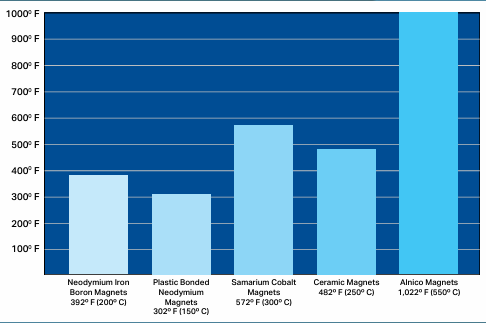
Neodymium magnets are a type of rare earth magnet and are the most common rare earth permanent magnets in the world. They are composed of Neodymium (Nd), Iron (Fe) and Boron (B), and exhibit the highest maximum energy product of any permanent magnet material. However, these magnets are vulnerable to corrosion if they are exposed to the elements. To protect the magnet from corrosion, the magnet is usually coated with nickel. Other coating options are aluminium, zinc, tin, copper, epoxy, silver and gold.
- Bonded NdFeB magnets can be compression or injection moulded to f inal shape. These high tolerances can be achieved without the need for further machining
- Injection moulded magnets are available in both neodymium and ferrite varieties
- Injection moulded ferrite magnets offer high durability and resistance to shock, as well as a low cost and extreme resistance to corrosion and conditions such as low density.
- Available in high tolerance and complex shapes.
- No coating required, although black epoxy and Parylene coatings are available.
Samarium Cobalt Magnets
Samarium cobalt magnets are rare earth magnets that offer high maximum energy products and can operate in high temperature environments. They are extremely strong and typically allow for smaller size magnet profiles. Though not as strong as neodymium magnets, samarium cobalt magnets present three significant advantages. They work over a wider temperature range, have superior temperature coefficients, and also have a greater resistance to corrosion. Special coatings are available for
specific marine and automotive applications. Samarium cobalt magnets are one of the most useful magnets for high temperature applications. They retain most of their energy up to 300°C, making them ideal replacements for Alnico magnets when high temperature use or miniaturization is required. Samarium cobalt magnets are known for their excellent temperature stability—maximum use temperatures are between 120 and 290°C; Curie temperatures range from 370 to 425°C
Ceramic
Ceramic magnets, or ferrite magnets, are low cost, lightweight, moderate energy permanent magnets capable of withstanding operating temperatures of up to 250°C. They are highly corrosion resistant and work well in high volume applications. Ceramic magnets can be made in many shapes and sizes, can be ground to intricate and accurate shapes, and can even be designed to be small enough to be used in micro applications.
Alnico Magnets
Alnico magnets are alloys comprised of aluminium, nickel, iron, and cobalt. They have the highest operating temperature and temperature stability of any permanent magnetic material. They retain approximately 85% of room temperature magnetisation at temperatures of up to 540°C. They possess high residual induction as well as relatively high energies. Alnico magnets naturally possess an excellent corrosion resistance
MAGNETIC SEPARATION
Safeguard your product quality and protect your processing equipment with Bunting’s line of magnetic separation products. Separation of metal contaminants is an essential step in the production of food and pharmaceutical products. Bunting manufactures an extensive line of magnetic separation equipment that removes contaminants from avariety of material consistencies, including dry particulates, liquids, and slurries. We offer units designed to remove metal contamination from gravity, mechanical, andpneumatic conveying systems. Metal contaminants in a production line present not only a risk to a consumer who may bite into a sharp piece of scrap metal, but also to the other equipment in your facility. Our magnetic separation equipment pulls contaminants out of the production line quickly and efficiently, sparing you the costs of repairing or replacing equipment such as grinders that could be seriously damaged if a piece of metal scrap were to pass through. In addition to causing harm to the consumer and to other equipment within a facility, metal contamination found in a product can seriously damage a manufacturer’s brand and reputation. We are proud to be the first company in the metal separation industry to have earned USDA and AMS acceptance for our sanitary-grade metal separators. Bunting engineers have made it a priority to stay on top of the constantly changing marketplace and government requirements regarding the safety and purity of food and pharmaceutical products. We welcome the challenge of ever more stringent guidelines as we are driven to continuously improve our product offerings
Plate Magnets
Bunting supplies various types of plate-based magnetic separators that can be implemented into a broad range of applications, and can be used with an equally wide range of materials. All plate magnets are designed for the capture of tramp metal in gravity free-fall applications. Metal-detectable gaskets and grommets are standard features in housing of plate magnets.
STANDARD PLATE MAGNETS
Standard Plate Magnets are available with permanent ceramic magnets or with high-intensity permanent rare earth magnets. Both types of magnets work efficiently to capture fine metal particles and slightly magnetic debris from powdery, moist, clumpy, or abrasive materials that might choke or wear cartridge-based separators. Plate magnets install easily in chutes to remove ferrous fine particles and larger pieces of tramp iron from many types of free-flowing and pneumatically conveyed material. They can also be installed above conveyors or below conveyor drive pulleys to capture contaminants as material drops from open belts. Standard installation kits include a pre-drilled hinge, latch, and other hardware to ensure easy mounting. The tapered magnetic face is designed to prevent contaminant wipe-off in rapid product flow. Standard plate magnets are available in widths from 10 to 150cm.
- Ideal for 30° to 60° inclines, allowing contaminants to be trapped as material flows over the plate magnets.
- Food and sanitary available to fit your production safety regulations
- Hinged plates swing out for easy cleaning.
- 300 series SS construction. 316 stainless steel available when required. Tapered step face to prevent product wipe off in rapid product flow is standard with 400 stainless steel.
- Rare earth magnets are available to provide maximum strength and reach out.
- Optional replaceable grain face available for dealing with abrasive materials.
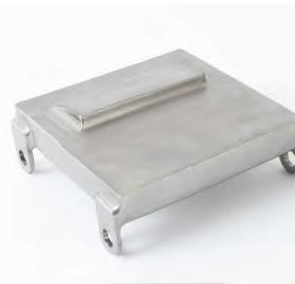
PLATE HOUSING MAGNETS
Plate Housing Magnets resist bridging and choking to remove tramp iron and ferrous fine particles from flow resistant bulk materials. The stainless steel housings mount easily to enclosed spouting or directly on processing equipment. Optional square, rectangular, and round adapters can be supplied or designed to your specifications for ease of installation. A baffle at the top of the housing helps break up clumps and directs product flow over the unit’s two powerful plate magnets
- Excellent for separation of coarse, fluffy, and other flow resistant materials that bridge in grates and drawer magnets.
- A diverter at the top of the housing helps break up clumps and directs product flow over the unit’s two powerful plate magnets. Additional removable/replaceable diverters are available.
- Custom transitions for round, square, or rectangular spouting are available to fit any application.
- Economical ceramic and powerful rare earth magnets are both available based on your production needs.
- A self-cleaning option is available for increased efficiency.
- Compact design fits easily into limited spaces, which allows for mounting on processing equipment or on spouting.
- Rugged stainless steel construction resists wear and extends life of equipment
SUSPENDED PLATE MAGNETS
Bunting suspended plate magnets are designed to be suspended above open conveyors to remove ferrous objects and fines found in grains, feedstuffs, raw and processed food products, dry powders, and other particulates.
- The stainless steel design complies with food and sanitary grade requirements.
- The magnet suspends over a conveyor belt or drop-off point to remove contaminants from dry powders, grains and particulates without interrupting the product flow.
- The powerful ceramic magnet field reaches deep into conveyed material to pull ferrous tramp from flat-belt and trough conveyers. Rare earth magnet models are available for applications that require greater magnetic power.
- Sturdy, free-standing, bolt-together support frames enable convenient mounting.
- Optional stripper plate slides out for fast, easy, out-of-the-way cleaning.
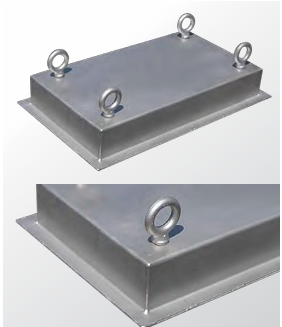
Our Suspended Plates come in sizes matched to common belt widths and are outfitted with eye-bolts to aid in handling and overhead suspension.
- 950 Suspended Plates are designed for deep 25cm reachout troughing applications and for high conveyor speeds of 0.5 to 1.5 mps.
- 650 Suspended Plates are designed for medium-duty and lighter burden depth where 16cm reachout is adequate. The 650 Series is a cost effective choice when dealing with lighter product density, lower conveyor speeds, or thinner burden depths
- 450 Suspended Plates are designed for light-duty flat belt applications with a 16cm reachout. They can be upgraded from ceramic to rare earth magnets, resulting in higher intensity magnetic fields to separate metal fines from thin, light layers of products conveyed at speeds under 0.5 mps on flat belts
HUMP MAGNETS
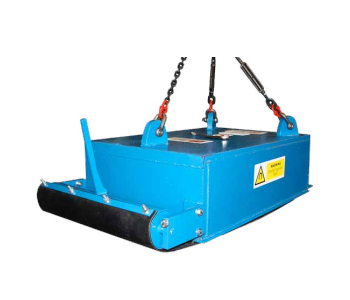
Hump magnet separators are specifically built to handle high volume product flow. Available in hump and half-hump housings, they are designed for installation in enclosed flow lines or on processing equipment.
STANDARD HUMP MAGNETS
Hump magnet housings handle gravity, moderate positive, and negative pressures. Their angled shape directs the product flow into the magnetic field, helps prevent build-up and bridging, and assists in breaking up clumps of product for increased protection against entrapped ferrous debris.
- Select double or single hump housings sized and outfitted to your specs.
- Available with mild steel or stainless steel construction. Custom transitions for round, square, or rectangular spouting are available to fit any application.
- Hinged plate magnets swing open for quick manual cleaning.
- Self-cleaning models reduce cleaning time and labour.
HALF HUMP MAGNETS
- Half-hump magnets are used where standard hump magnets will not fit because of height restrictions. Like its larger version, the half-hump housing directs the material flow over the single high-strength permanent magnet, and breaks up aggregated material to dislodge and capture embedded metal contaminants.
HF Drawer Magnets
- Bunting HF Series Drawer Magnets are equipped with powerful magnetic cartridges to handle a wide range of separation tasks in mechanical or gravity flow applications. They can be configured with up to 5 cartridge trays, arranged so that the cartridges are staggered to increase contact with the product stream. Material moves in a waterfall flow pattern from one cartridge tray to the next, resulting in exceptionally thorough cleaning.
Product Features:
- Available in utility, food, and sanitary construction grades to suit your safety regulations, with multiple cleaning options and stainless steel housings.
- Bunting supplies custom transitions to match round, square, or rectangular spouting, allowing for a simple, secure fit with your existing equipment.
- Multiple trays provide increased contact with product flow for more complete metal capture.
- HF Drawer Magnets are available with the NUHI™ Neo Ultra High Intensity Cartridge Magnet. Completely redesigned from the ground up to address the processing challenges manufacturers face, the NUHI™ cartridge is nearly 20% stronger and delivers 50% more reach out than our previous cartridge design. The result is more power, a purer product, and improved plant efficiency. Ceramic and rare earth magnets are also available.
- Manual standard, manual self-cleaning, pneumatic self-cleaning and pneumatic continuous self-cleaning configuration options are available.